THE DREAM JOURNAL
School Dream Meaning: Pressure, Belonging, Lessons, and Personal Growth
A reflective guide to possible meanings. Your own experiences and feelings matter more than any dream dictionary.

- Schools in dreams often point to growth, pressure, evaluation, social identity, or a lesson your mind still feels is unfinished.
- The emotional tone matters: a calm school dream may suggest readiness to learn, while a chaotic or late-for-class dream often reflects stress or self-doubt.
- Dreams about school can connect to present-day responsibilities even when they seem rooted in childhood memories.
- The strongest interpretations usually come from linking the dream setting to current fears, goals, relationships, and expectations.
Dreams about schools rarely mean only one thing. Because school combines learning, authority, routine, rules, friendships, comparison, and performance, it becomes a powerful symbol in the dreaming mind. A school dream can reflect current pressure at work, the feeling that life is testing you, the wish to improve, or an old emotional pattern that still surfaces when you feel watched, judged, or behind.
Dreaming about school usually suggests that some part of life feels like a lesson, a test, or a period of development. Your mind may be revisiting themes like preparation, confidence, belonging, pressure, memory, and whether you feel ready for what comes next.
If the dream focuses on exams, lateness, forgotten homework, old classmates, or wandering the building, it often points to stress, unfinished emotional business, or the feeling that your progress is being measured. If the dream feels supportive or curious, it can point to growth and readiness.
Core Meaning of School Dreams
A school dream often appears when life feels developmental rather than settled. In practical terms, that can mean you are learning a new role, adjusting to higher expectations, navigating social comparison, or feeling that you are being assessed by other people or by yourself. The dream does not need to be about actual education to use the school setting. It uses school because school is one of the clearest places where many people first learned what it feels like to succeed, fail, fit in, feel embarrassed, or seek approval.
This is why school dreams frequently return during job changes, family stress, creative projects, public-facing work, and emotionally demanding transitions. The dreaming mind may be saying: you are still learning this; you still care how you are seen; or there is a lesson you are not fully integrating yet. For some people, the symbol is gentle and motivating. For others, it revives old tension around perfectionism, authority, or not feeling good enough.
Because dreams are shaped by emotion as much as imagery, the mood of the school matters. A bright, welcoming school can suggest readiness, curiosity, or re-engagement with personal growth. A confusing, locked, noisy, or hostile school often points to mental overload, comparison, unresolved anxiety, or the fear that you are missing something important.
Schools combine memory, rules, belonging, evaluation, and future pressure in one place. That makes them one of the richest dream settings for reading emotional patterns without forcing a single fixed meaning.
Key Emotional Themes Inside the Dream
Most school dreams cluster around a few repeating emotional themes. Looking for these themes is usually more useful than taking every object literally. Ask yourself what the school felt like emotionally before asking what every classroom item might symbolize.
The dream may be about performance, belonging, fear of falling behind, the wish to do better, or the memory of older social wounds. In many cases, several themes overlap.
Performance Pressure
A test, timetable, teacher, or late arrival can reflect the feeling that life is grading you right now.
- You feel watched or evaluated.
- You are trying to avoid mistakes.
- You fear not meeting expectations you care about.
Belonging and Social Identity
Hallways, classmates, lunchrooms, and group assignments often point to where you fit in socially or emotionally.
- You want acceptance or reassurance.
- You are comparing your progress with others.
- You are revisiting older social dynamics.
Unfinished Lessons
Returning to an old school can suggest a pattern, fear, or emotional lesson that has not fully resolved.
- The same trigger keeps returning.
- A past memory still shapes present reactions.
- You sense that life is asking for growth, not punishment.
Preparation and Readiness
Finding the right classroom or finally understanding the schedule can symbolize growing clarity.
- You are organizing your next step.
- You are building skill and confidence.
- You are moving from confusion into competence.
Common School Dream Scenarios
Specific scenes inside a school dream add nuance. These are not rigid formulas, but they can help you notice what your subconscious is emphasizing.
Try reading the scene through the question: what does this situation feel like in waking life?
Being Late for Class
This often reflects the fear of missing an opportunity, arriving unprepared, or feeling behind compared with others.
- Common during heavy workloads or deadlines.
- May mirror imposter syndrome.
- Can signal time pressure more than failure.
Taking an Exam
Exam dreams frequently reflect evaluation anxiety and the pressure to prove yourself.
- You may be anticipating judgment.
- You may be testing your own readiness.
- The topic of the exam can hint at the area of life under stress.
Walking Empty Corridors
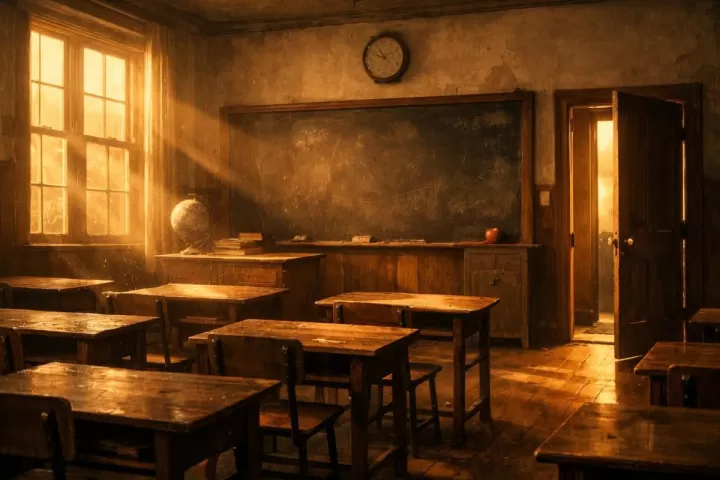
An empty school can feel eerie but also reflective. It often suggests memory, distance, or looking inward.
- You may be reviewing the past.
- You may feel disconnected from community.
- You may be searching for direction.
Meeting Old Classmates or Teachers
These figures often represent old versions of you, old beliefs, or authority patterns you are still negotiating.
- A classmate may symbolize comparison.
- A teacher may symbolize guidance or judgment.
- The interaction matters more than the face alone.
What This Dream May Say About Your Life Right Now
When school appears in a dream, it often reflects present-day self-evaluation. You may be in a season where results matter, where you are learning in public, or where older fears are being activated by new responsibility. The dream can be a mirror for how you handle correction, comparison, authority, and uncertainty.
In adults, school dreams often return during promotions, interviews, new relationships, parenting, creative launches, or periods of self-reinvention. The subconscious uses the familiar school setting to translate a simple emotional truth: this matters to me, I want to do well, and I am not completely certain I am ready.
That is why the dream is not always negative. It may appear because you are growing. Growth can feel exciting and vulnerable at the same time. If the dream leaves you tense, it may be nudging you to reduce unnecessary pressure, prepare more clearly, or separate your worth from performance.
Where in life do you currently feel judged, tested, or compared? What standards are healthy, and which ones come from older fear? What would “prepared enough” honestly look like right now?
Psychological and Spiritual Angles
From a psychological angle, school dreams fit with the way dreams often process emotion, memory, and challenge. Dreaming is closely linked with REM sleep, when vivid mental imagery is common. Research and clinical explanations do not support one universal dictionary meaning for school symbols, but they do support the idea that emotionally loaded settings can become recurring dream material when the mind is processing stress, memory, and adaptation.
Spiritually, some people read school dreams as a symbol of soul-level learning, humility, discipline, timing, and maturity. In that lens, the classroom is less about punishment and more about formation. You are being shown what you still need to notice, practice, release, or embody. The healthiest spiritual reading is still grounded in your real life rather than fear-based prediction.
A balanced interpretation respects both perspectives: the dream can be meaningful without pretending it is a literal prophecy. The more useful question is what truth about your emotional life the dream is inviting you to face with honesty.
A school dream is usually most helpful when it leads to reflection, not superstition. Use it to notice pressure patterns, confidence gaps, and growth edges that are already active in waking life.
How to Work With a School Dream
Start by recording the exact scene. Write down whether you were a child or an adult in the dream, whether the building was familiar or strange, and what emotion rose first: panic, embarrassment, curiosity, relief, or determination. Those details help narrow the interpretation far better than a single dream symbol alone.
Next, connect the dream to a current situation. Ask yourself where you feel evaluated, compared, or in training. If the dream repeats, it may be highlighting a persistent belief such as “I must never be wrong,” “I am behind,” or “I have to earn approval.” Naming the belief can take much of the dream’s emotional charge away.
Finally, respond practically. That might mean preparing for something specific, asking for support, setting gentler standards, or celebrating progress you have ignored. Dreams can point to internal pressure, but your waking response is where change happens.
Journal the Scene
Write the dream before the details fade.
- What room were you in?
- Who seemed powerful in the dream?
- What felt urgent or unresolved?
Name the Pressure
Translate dream tension into waking language.
- What are you trying not to fail at?
- Who do you want approval from?
- What would enough preparation look like?
Look for Old Patterns
See whether the dream revives a familiar emotional script.
- Perfectionism
- Fear of embarrassment
- Comparison with peers
Take One Real-World Step
Use the dream as a prompt for action rather than rumination.
- Prepare for the task in front of you.
- Ask a trusted person for perspective.
- Rest if your mind is overloaded.
If dreams are frequent, highly distressing, or tied to major sleep disruption, they are worth discussing with a qualified health professional. Dream reflection can be helpful, but it is not a replacement for care.